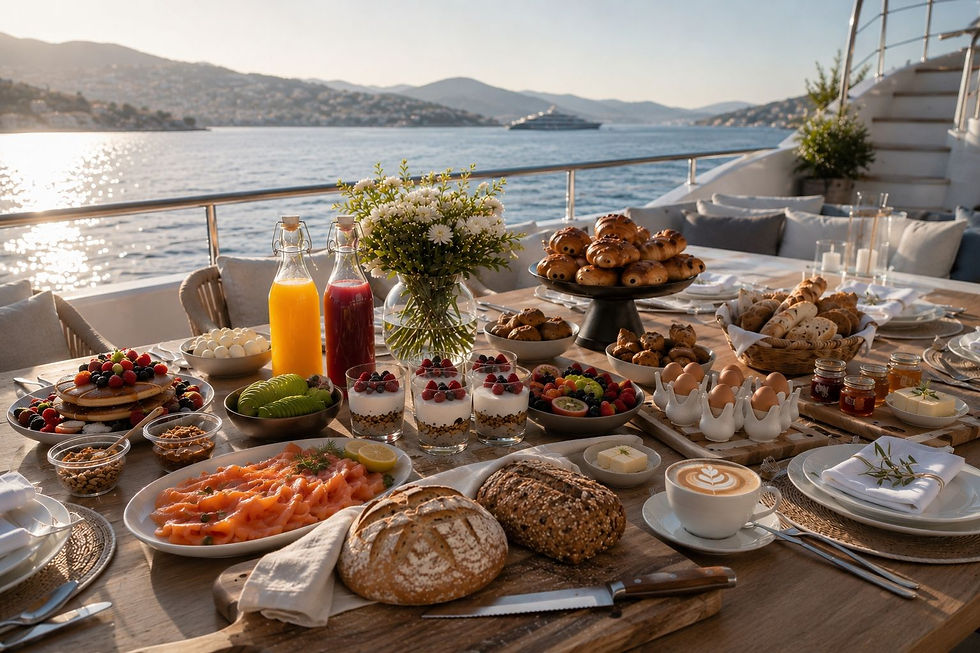
Private chef for MIPIM in Cannes: hosting a dinner whose guest count shifts until the last minute
Contents
Introduction
A dinner held during MIPIM is always prepared with one unknown: the number of guests who will actually sit down at the table. Invitations are confirmed as the trade show's meetings unfold, and the guest list closes late, sometimes on the evening itself.
This uncertainty is not a failing in the client's organisation; it is the very nature of a trade-show week on the Croisette. A private chef must therefore design an elastic service, able to absorb last-minute arrivals as well as group cancellations.
This article describes the method applied at Monsieur et Madame to hold a dinner whose guest count keeps moving: a preliminary consultation, a menu built from modular components, sourcing with a reasoned margin, staggered mise en place and a service format chosen for its flexibility. None of it is improvisation, and everything is decided in advance.
You will also find the three decision points of a service day and the mistakes that derail this kind of evening. The subject is a matter of organisation, never of pricing: a bespoke quote is drawn up after an initial conversation.
Why the guest count for a MIPIM dinner is never final
MIPIM packs into four days meetings that are arranged on the spot, between two pavilions and a stand. A delegation arrives with a provisional schedule, and that schedule is rewritten every morning according to business opportunities.
A private dinner in a villa or an apartment on the Croisette serves precisely to extend these meetings in a calm setting. It therefore welcomes guests who were not expected the day before, and sometimes loses confirmed guests held up by a meeting that runs late.
This is what we observe on our assignments as a private chef for MIPIM in Cannes. The gap between the announced guest count and the number actually served is the rule rather than the exception.
Three causes of variation, all foreseeable
The first is the courtesy invitation, extended at the end of the day to a contact met on a stand. The second is the delay, when an expected guest is held up at the Palais des Festivals and joins the table late.
The third is the group effect, when a company decides to bring its entire team rather than its two directors. Each of these causes is known in advance, and none can be predicted individually.
What the client really expects
The client does not ask for an exact menu; they ask that no one notices the movement. An extra guest must be seated and served as if they were expected, with no improvised dish and no mismatched plate.
The preliminary consultation: what is set, what stays open
Everything begins with a conversation with the organiser, most often the executive assistant or the company's events manager. This consultation does not seek a final number; it seeks a range and a ceiling.
The floor is the number of guests who are certain, those staying at the villa or who have already set aside their evening. The ceiling is the maximum number that the table, the kitchen and the service can accommodate without changing the set-up.
Between the two lies the elastic zone, and it is this zone that shapes all the preparation. The earlier it is announced, the more calmly the margin can be prepared, in terms of produce as well as kitchen team time.
The four pieces of information that change everything
We always ask for the floor, the ceiling, the cut-off time after which no further additions are possible, and the name of the person who makes the call on the day. This last piece of information is the one most often forgotten, and the most valuable.
Without a single point of contact, the chef receives three contradictory versions of the guest count within the same hour. With one, a single decision circulates and the kitchen follows without hesitation.
Writing an elastic menu rather than an exact one
A business dinner menu is usually built for a fixed number, with plated presentation calibrated to the exact cover. In the context of the trade show, this logic is reversed: we write a menu built from modular components, some of which can be multiplied without losing their character.
Building a trade-show menu follows a similar logic, which we detailed when discussing a menu that holds up over four days of receptions. The common principle is simple: the produce is varied, the menu is not repeated.
The families of dishes that duplicate well
Cold amuse-bouches, starters assembled to order and desserts portioned in advance readily accommodate extra covers. An additional serving is plated in a matter of seconds, without affecting the rest of the service.
Conversely, a last-minute cooking of a whole shared joint and a highly architectural presentation cope poorly with movement. These dishes remain possible, but they are placed on the certain part of the guest count.
The pivot dish, insurance for the middle of the meal
We systematically place at the heart of the meal a so-called pivot dish, designed to serve from twelve to twenty covers without any change to the recipe. It is often a low-temperature preparation kept warm and portioned at service, which absorbs late variations.
Sourcing with a margin, without waste
Buying for the ceiling when we may only serve the floor would be a ruinously expensive shortcut in terms of produce. We therefore work through staggered purchasing and a targeted margin, rather than general over-buying.
One trip to the market, two levels of ordering
The core of the menu is bought the day before, from our producers and at the market, for the certain number. The elasticity margin is ordered separately, on produce that keeps without loss and can be reused the next day.
Dry goods, aged cheeses, citrus fruits and storage vegetables fall into this category. Seafood and fresh herbs never do, because their window is too short.
Refrigeration, the overriding constraint on the margin
A produce margin only makes sense if it can be stored in the conditions of a villa kitchen, often equipped with a single domestic refrigerator. Respecting the cold chain therefore governs the volume of the margin as much as the menu itself.
We stagger deliveries rather than stockpiling, and we record temperatures at every delivery of goods. This record is a working document, not an administrative formality.
Mise en place that absorbs the variations
Mise en place is the real lever of elasticity for a dinner with a shifting guest count. Everything produced in advance duplicates easily, whereas everything done at the last minute comes at a cost during service.
Producing in batches, plating on demand
Bases, stocks, mixtures and garnishes are prepared in batches slightly above the floor. The finishing touches are held back, so that each plate is assembled for the announced cover and not the assumed one.
This logic of advance production echoes the one we described in our latest article on setting up a pop-up kitchen in a space without a kitchen. In both cases, the work shifts upstream to free up the service.
The ghost place setting, a simple and effective measure
We always prepare two place settings more than the announced guest count, set aside in the pantry and ready to join the table. This ghost place setting avoids the scene that gives everything away: a guest left standing while their place is improvised.
Service format, the first lever of elasticity
The chosen format determines the range the service can absorb without losing its shape. A seated dinner with plated service is the most demanding, a cocktail dinner the most flexible, and French-style service sits between the two.
What each format forgives
Plated service requires an exact number of servings and a fixed seating plan, which makes it sensitive to the slightest addition. A cocktail dinner, by contrast, almost ignores the guest count as long as the volume of pieces keeps pace.
French-style service, where dishes are presented at the table, accommodates two or three extra guests without changing the quantities plated. It is often the most balanced compromise for a trade-show dinner.
A villa kitchen also imposes its own production limits, as we have shown in the past (a birthday dinner for twenty guests). The format is therefore chosen not only according to numbers, but also according to the stove available on site.
The seating plan, or its deliberate absence
When the announced range exceeds four guests, we recommend dispensing with a named seating plan. A table without place cards can be rearranged discreetly, whereas a named plan reveals every absence for all to see.
On the day of the dinner: three decision points
The service day is organised around three moments when the guest count becomes a little more fixed. Knowing them makes it possible to decide without haste, and without calling the client every hour.
Three check-ins set in advance
The first check-in takes place in the late morning: the organiser confirms the floor and flags any changes already known. Batch production then begins, at the floor plus two covers.
The second check-in comes in mid-afternoon, when the trade-show meetings wind down. This is when the margin is committed or released, and when the garnishes are topped up if necessary.
The third check-in comes about an hour before service, and it closes the guest count for good. After it, the kitchen no longer accepts additions to the menu, only an extra place setting at the table.
The role of the chef in residence
When a delegation stays on site for the whole week, these three check-ins take place over a coffee, without any appointment. The guest count then circulates continuously, and information is no longer lost between two messages.
This is one of the advantages of the formula detailed in our article on the chef in residence for a delegation staying on the Croisette. Having the duo in the house turns a constraint into flexibility.
What derails a dinner with a variable guest count
The failures we observe almost never come from the kitchen. They come from the flow of information, and from the precise moment when it breaks down.
The four most common mistakes
The first is accepting an unlimited range, with no written ceiling and no cut-off time. The second is overproducing as a precaution, which weighs down the service and ends in waste.
The third is letting two contacts pass on different guest counts. The fourth is forgetting the villa staff, who discover the running order at the moment of serving.
The blind spot is in the dining room
An extra cover can be cooked in a few minutes, but serving it means revisiting the entire dining-room running order. That is where incidents occur, and that is why we go over the service sequence out loud before every dinner.
One last pitfall deserves to be named, because it remains invisible until dessert. A table that grows during the evening inevitably lengthens the meal, and the pace must tighten for the evening to keep its poise.
Summary table of variations and how we respond
Variation observed | When it occurs | Kitchen response | Dining-room response |
Two extra guests | Mid-afternoon | Margin committed, batches topped up | Ghost place settings set |
A whole group announced | Pre-service check-in | Switch to the pivot dish | French-style service |
Three late cancellations | During the aperitif | Margin carried over to the next day | Table closed up without place cards |
Arrival mid-meal | During service | Discreet revision of the running order |
Illustrative service case
What follows is a typical scenario, reconstructed to illustrate the method, and not an account of an actual service. This text reports no client remarks and quotes no one.
An asset management company rents a villa in the hills above Cannes for the week of the trade show. The dinner on the second evening is announced for twelve guests, with an accepted range of up to eighteen and a cut-off time set for late afternoon.
The duo builds a modular menu around a low-temperature pivot dish, buys the core at the market for the certain number and orders its margin on produce that keeps. The batches are started at the floor plus two, and the finishing touches are held back.
At the mid-afternoon check-in, the organiser announces four extra guests, then one cancellation. The margin is committed, the format switches from plated service to French-style service, and the table loses its named seating plan.
One guest nevertheless arrives during the main course, well after the guest count has closed. The incident does not come from the kitchen, which was holding a starter in reserve, but from the villa staff, who seat the latecomer somewhere other than at the planned place setting.
The running order is revised in the dining room in a few moments and the evening ends without anything showing. The lesson fits in one sentence: going over the running order with the household staff mattered as much as the mise en place.
Frequently asked questions
Until when can guests be added to a dinner during MIPIM?
Together we set a cut-off time, generally one hour before service. After that, a place setting can still be added at the table, but the menu no longer changes.
Should a different menu be planned for last-minute guests?
Never, and that is the whole point of the modular menu. Every guest receives the same menu, because the dishes have been chosen to be duplicated without losing their character.
What happens to the produce margin if no extra guests come?
It is ordered on produce that keeps, precisely for this reason. It is reused at the next meal of the stay, which avoids any waste without reducing flexibility.
Is a cocktail dinner preferable to a seated dinner in this context?
It is more flexible, but it does not replace a seated dinner when the aim is to talk business in a calm setting. The choice depends on the purpose of the evening and on the villa, and the French-style format often offers the best balance.
Do you also cater for dietary requirements and allergies?
Yes, and this information goes into the menu from the very first draft, not as a last-minute correction. Vegetarian, gluten-free, vegan or kosher-friendly versions are prepared like all the others, without a separate table.
Do you work anywhere other than villas during the trade show?
We work in villas, in apartments and on board, from breakfast to dinner. Each venue imposes its own production constraints, and the menu is written after the kitchen visit.
Organising your MIPIM dinner in Cannes
Monsieur et Madame, the duo formed by Lory Herschkorn and Fabien Mimoun, work in Cannes in villas as well as on board, throughout the week of the trade show. Tell us about your evening, its floor and its range.
Describe your project on the contact page, specifying the date, the venue and the expected guest count. A bespoke quote will be sent to you after this exchange.