


Private chef for Tax Free World in Cannes: the category managers' working lunch in a private villa
Contents
Introduction
Every autumn in Cannes, the Tax Free World Exhibition brings together the buyers and category managers of global travel retail. Between two stand meetings, a brand's range review is often decided around a table, far from the noise of the show floor.
This working lunch is not a showcase dinner. It must properly feed six to twenty people in about two hours**, without breaking the thread of a discussion about SKUs, shelf space and order volumes.
Lory Herschkorn and Fabien Mimoun, the Marseille private chef duo, create these lunches in rented villas in the hills above Cannes or along the Croisette. Their method comes down to four steps: written brief, technical visit, sequenced menu, right-sized brigade.
This article details the full course of such a service, from defining the requirement to restoring the villa afterwards. It also explains what changes compared with an evening service: the pace, the portions, the drinks and the role of plated presentation.
The working lunch, the only free slot in a trade show day
During Tax Free World week, the meeting rooms at the Palais des Festivals are booked months in advance. Brands wanting an in-depth conversation with their buyers therefore look for a private venue, fifteen minutes from the Palais.
The city of Cannes has a stock of reception villas that exhibitors book exclusively for the duration of the show. Our role as a private chef for Tax Free World in Cannes starts there: turning a rental kitchen into a reliable workstation.
A show that saturates the meeting rooms
Meeting slots at the show are negotiated by the half hour and move without notice. A lunch away from the venue offers a setting the organiser cannot reschedule.
The benefit is not only logistical. A table laid in an enclosed garden defuses the negotiating stance and lets the conversation go further than a stand meeting.
Why lunch becomes the slot that counts
Breakfast is short, and dinner comes after a twelve-hour day at the show. Lunch is the only moment when minds are still free to make a decision.
So we fit the service to the agenda, not the other way round. The kitchen adapts to the sequence of the meeting, even delaying a course by twenty minutes if a discussion point runs over.
The rhythm of an exhibition day
The aisles open early and meetings follow one another until late afternoon. A guest arriving at the table has already walked several kilometres around the stands and tasted a dozen sweet products.
This fact shapes the entire menu. It calls for savoury, easily digestible dishes low in sugar, because the day of tastings has already saturated the palate.
Framing the range review before writing a single line of the menu
A working lunch is prepared like a restaurant service, but with one additional constraint: the purpose of the meeting is the real specification. A range review is not served the way a contract signing is.
We therefore ask the client a series of questions before making any culinary proposal. No menu is written until the brief has been approved in writing.
The questions to ask the client
How many guests, which nationalities, which dietary restrictions, how long will the session really last? These four answers alone determine the structure of the menu.
We also ask whether product samples will be presented at the table. A tray of spirits or confectionery placed in the centre changes the order of the courses and the style of presentation.
The purpose of the session dictates the service
A presentation session can accommodate plated service, well paced and silent. A tough negotiation, on the other hand, calls for a single dish set down just once, then no one left in the room.
We had already explained this for an off-site day in our latest article on the 4x4 culinary safari during MIPIM: the culinary sequence must follow the client's programme, not the chef's habits.
The written brief, the only binding document
We always send back a one-page brief summarising the number of covers, the timings and the diets recorded. This document serves as the single reference on the day of service.
Any late change is recorded on it and dated. A request that arrives the evening before is accepted only if sourcing still allows it.
Scouting the villa and assessing its kitchen
Most villas on the Côte d'Azur are equipped for family cooking, not for a twenty-cover service. The technical visit is therefore mandatory before any confirmation.
We carry it out with the owner or the rental agency, tape measure and notebook in hand. Worktop space, extraction and a water point determine feasibility.
The technical visit of the kitchen
We measure the available length of worktop, the capacity of the ovens and the power of the hobs. A domestic induction hob rules out certain last-minute cooking methods.
Refrigeration is the second item we examine. We check the usable refrigerated volume and whether there is a blast chiller or an ice container for the morning mise en place.
The guests' route and the brigade's route
A villa service rarely fails because of the kitchen, and often because of circulation. The path of the plates must never cross the path of the guests.
So we map out two separate routes from the scouting visit onwards, with a relay pantry on the way to the dining room. An intermediate service station saves an entire round of service at a twenty-cover lunch.
Extraction, water, electricity: the three sticking points
Without adequate extraction, cooking fish can scent an entire villa for the whole day. We then switch to gentle cooking and oven finishes.
The electrical supply is the second risk, as several professional appliances on the same line will trip the fuse box. We spread the appliances across two separate circuits and bring a backup gas burner.
October sourcing around Cannes
The show takes place at the turn of October, when Provence shifts to autumn produce. Local sourcing then becomes a genuine menu asset, not a stylistic flourish.
We work with market gardeners from the Pays de Grasse and the fish auctions along the coast. Orders go out four days before the service, with an identified fallback for each item.
October produce between Cannes and Marseille
October brings Muscat grapes from the Ventoux, the very last figs of the season, the first ceps and chestnuts from the Massif des Maures. Butternut squash, fennel and chard cover the vegetable repertoire.
The first Corsican clementines arrive at the end of the month and open the dessert season. Green table olives, harvested in the Baux valley, accompany the amuse-bouche.
Fish auctions and rockfish
Mediterranean rockfish is at its best at this time of year. Red mullet, dentex, scorpionfish and pandora make up our core list for a trade show lunch.
We buy at the Marseille fish auction or from the small-scale fishermen of the Gulf of La Napoule. Whole fish is filleted at the villa, never bought as pre-packed fillets the day before.
Building a menu that does not interrupt the working session
A working lunch imposes a simple rule: no dish should force a guest to put down their pen. Bones, shells and runny sauces come off the menu.
So we build a short progression, in three stages at most. An amuse-bouche, a main course and a light dessert are enough to carry a two-hour session.
An amuse-bouche that leaves hands free
The amuse-bouche is taken standing, before the table is taken over by files. A single bite, easy to pick up with one hand, replaces the classic platter of canapés.
We favour an autumn vegetable base with a touch of acidity. Roasted squash, brousse du Rove and a few shards of walnut make for an understated opening.
The single main course and its two variations
The main course goes out in just two versions, one from the sea and one plant-based. This binary choice prevents service errors when the room is deep in discussion.
Low-temperature cooking secures the send-out, as it can absorb a twenty-minute delay. Red mullet confit in olive oil and squash in two textures form a pairing that holds for half an hour.
Plated presentation versus sharing dishes in the centre
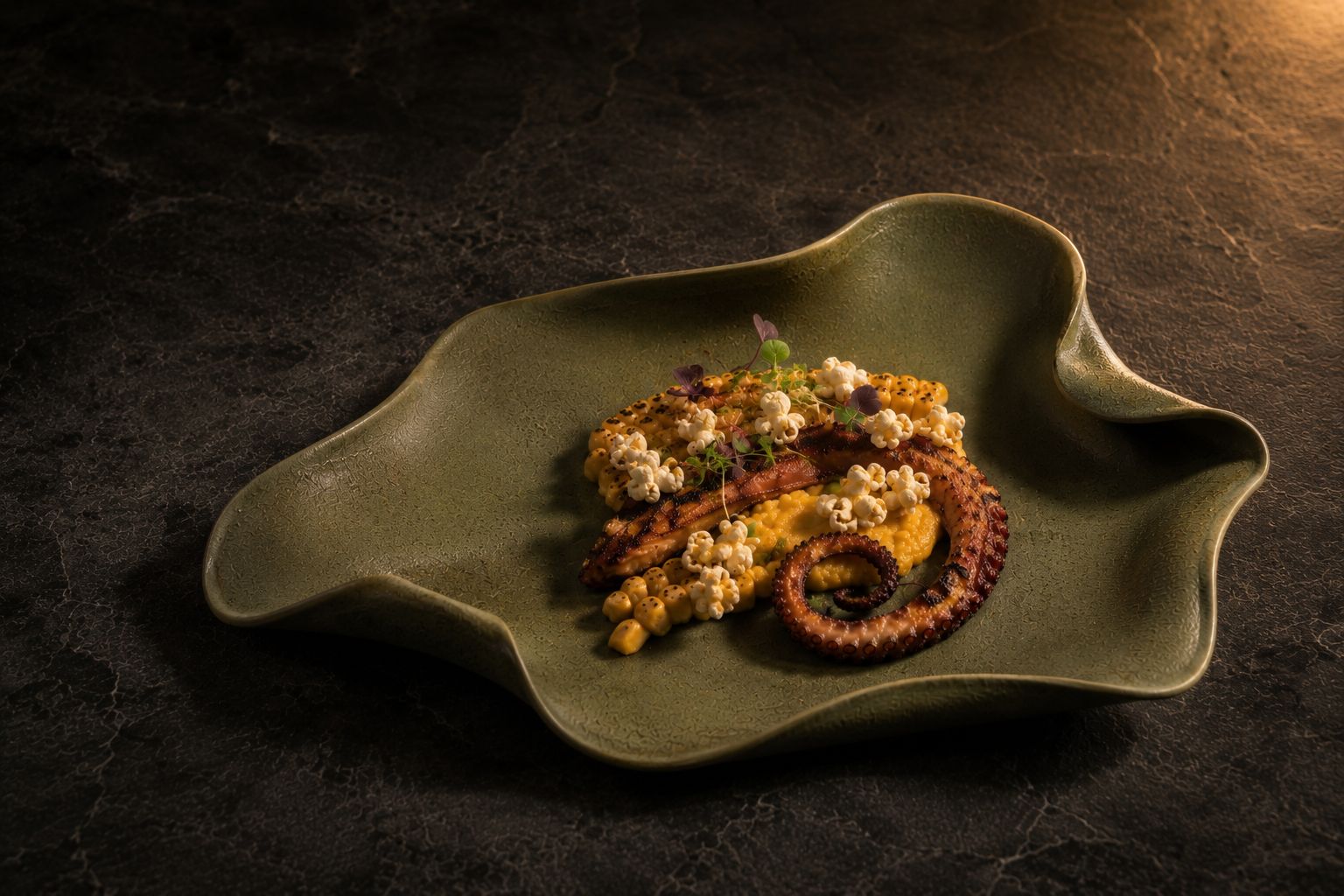
Plated presentation looks refined but keeps staff in the room longer. A dish set in the centre frees the service in a single intervention.
We detailed the opposite trade-off for a stand service in our article on the live cooking demonstration, where the staging matters as much as the plate. In a villa, discretion takes precedence over demonstration.
Drinks for a lunch that remains working time
A trade show lunch ends with a return to the Palais and meetings until the evening. Daytime sobriety is therefore the default rule, set out in the brief from the start.
This constraint does not impoverish the table; it shifts the work elsewhere. Waters, exceptional teas and juices pressed to order become a pairing field in their own right.
Daytime sobriety, the default rule
We offer a single glass, served with the main course and never refilled automatically. Water carafes remain on the table at all times, filtered and flavoured with fennel or verjuice.
Hot infusions replace coffee on request at the end of the session. A verbena or a smoked tea closes the lunch without reigniting the conversation for another hour.
Food and wine pairing kept for dinner
Food and wine pairing remains entirely relevant, but in the evening, once the exhibition day is over. A negotiation lunch is not the right setting for a vertical tasting of vintages.
We keep this work for evening services, such as the dinner for fragrance and spirits exhibitors that we orchestrate during the same show. The two services are not run in the same way.
The pop-up brigade and villa service
A pop-up brigade is assembled for a single day, with team members who do not work together the rest of the year. Roles must therefore be written down, not assumed.
We post a job sheet for each person in the kitchen, with timings and expected tasks. Every team member knows the exact minute they leave the kitchen for the dining room.
Staffing according to the number of guests
A single chef runs the kitchen for up to ten guests, with a maître d'hôtel in the dining room. Beyond ten guests, an additional cook joins the kitchen.
The same reasoning applies to the dining room, where one maître d'hôtel serves ten covers without delay. A second front-of-house lead becomes necessary beyond ten covers.
French, silver or plated service
Plated service is the fastest and quietest of the three. It remains our default choice for a working lunch.
Silver service, where the dish is presented and then served, suits a single sharing dish. French service, where guests help themselves, slows down a timed session too much.
The threshold for doubling the brigade
The doubling threshold is set at ten guests, for kitchen and dining room alike. It depends not on the menu but on the number of plates to send out in the same window.
We applied this same threshold for a table on the move in our article on the dinner for a cruise retail delegation. The rule applies to all our trade show services.
Allergens, diets and traceability for an international panel
Travel retail brings together buyers from Asia, the Gulf and the Americas. A panel of fifteen guests almost always involves three different diets.
We record these constraints in the brief, then carry them over to each technical sheet. No substitution is improvised on the day of service.
Collecting diets and restrictions
We distinguish between allergy, intolerance, religious restriction and preference. The four are not handled the same way in the kitchen.
An allergy requires a dedicated station, separate boards and a separate send-out. A preference is handled with a variation of the dish of the day, without a parallel menu.
The cold chain in a villa kitchen
A rental villa has neither a cold room nor a temperature logger. We arrive with our own insulated containers and probes, with readings taken on departure and on arrival.
Sensitive products stay in cold boxes until the mise en place. Raw fish comes out of the cold only a quarter of an hour before cutting.
Technical sheets and traceability
Each dish has a technical sheet listing suppliers and batches. The labels of the products served are kept for forty-eight hours after the service.
This discipline comes from the restaurant world, not from events. It is the only serious answer to an allergen question raised in the middle of a session.
Summary table of villa lunch formats
Lunch format | Panel size | Brigade deployed | Service duration |
Small negotiation lunch | four to six guests | a chef and a maître d'hôtel | one hour thirty minutes |
Range review lunch | six to ten guests | a chef and a maître d'hôtel | two hours |
Seated lunch on the terrace | six to ten guests | a chef and a maître d'hôtel | two hours |
Extended panel lunch | eleven to twenty guests | a chef, a cook and two front-of-house leads | two hours thirty minutes |
Closing lunch of the show | eleven to twenty guests | a chef, a cook and two front-of-house leads | three hours |
The durations shown cover the service only, excluding mise en place and restoring the villa. The brigade arrives four hours before the first send-out and leaves the villa two hours after the last service.
This table is a starting point for discussion, never a fixed grid. The quote is drawn up after the technical visit of the kitchen, once the villa is known.
Illustrative service case
The situation described below is an educational reconstruction, based on real services. It reports the words of no identifiable person and constitutes neither a promise nor a guarantee of results.
A spirits house books a villa in the hills above Cannes to host twelve category managers for three days. The second day's lunch must fit into two hours, between a range presentation and a return to the Palais.
The villa's kitchen has only a domestic oven and weak extraction. The solution is low-temperature cooking started first thing in the morning, followed by a finish with no frying or high-heat searing.
The reconstructed account of the regional manager comes down to three sentences. “We needed a meal that would not make us lose the thread of the range review.”
The second sentence concerns the pace of the service. “The plates arrived during a ten-minute break, without anyone having to put their documents away.”
The third concerns the choice of produce. “The Asian buyers remembered the rockfish and the squash, after a whole morning of sweet tastings.”
The panel's dietary constraints included a gluten-free diet and two religious restrictions. All three cases were handled through variations of the single main course, without a parallel menu.
Reconstructed statements, anonymised case. No names, brands or real client data appear in this illustration.
Frequently asked questions
Does the villa need a professional kitchen to host a private chef?
No, a well-equipped domestic kitchen is enough in most cases. The technical visit determines which cooking methods are possible and, if necessary, we bring our own reheating equipment.
When should the villa and the brigade be booked for show week?
The finest reception houses around Cannes are snapped up very early, well before autumn. A commitment made two months in advance leaves time for sourcing and for recruiting the pop-up brigade.
Can the chef include the exhibiting brand's products in the menu?
Yes, this is a frequent request in travel retail, and it is prepared in advance. We test the pairing before the day of service to make sure a product from the range does not unbalance a dish.
How do you handle an international panel with very different dietary requirements?
Everything depends on collecting the constraints, recorded in the brief. A variation of the single main course covers most situations, without multiplying menus in the kitchen.
Can a working lunch be held on board a yacht rather than in a villa?
Yes, we also work in onboard galleys, where space and refrigeration constraints are tighter. The number of guests is generally smaller and the schedule even more tightly timed.
What is the difference between a working lunch and a showcase dinner?
Lunch favours digestibility, sobriety and service in a single intervention. Dinner allows a longer progression and a true food and wine pairing.
Organising your working lunch during Tax Free World
Monsieur et Madame designs and delivers these working lunches in Cannes, Monaco and all along the coast from Marseille. We take care of scouting, sourcing, the brigade and restoring the villa afterwards.
Tell us the date, the number of guests and the purpose of the session. The personalised quote is drawn up after the technical visit, and the contact page remains the quickest way to get in touch.
