


Private chef for Tax Free World in Cannes: the welcome brunch for a travel retail delegation
Contents
Introduction
Every autumn, the Tax Free World exhibition brings the entire travel retail industry to the Palais des Festivals in Cannes: buyers, airport operators and brand houses. Delegations arrive in waves, often straight off an overnight flight, and the first hour spent together sets the tone for the whole week.
The welcome brunch answers this precise constraint. It fills a slot that dinner cannot take, and it absorbs staggered arrivals without imposing a single service time.
This article describes the method applied to this format: mapping the arrivals, choosing the venue, building a continuous buffet and catering to an international panel. Each point starts from constraints measured on the ground in Cannes, and the quote is always drawn up after the technical survey of the venue.
The Monsieur et Madame duo brings together Lory Herschkorn and Fabien Mimoun, two chefs based in Marseille who travel throughout the Côte d'Azur. The welcome brunch has its place among the formats they run during the major Cannes trade shows, alongside private dinners and brand receptions.
Why a welcome brunch opens the week better than a dinner
A travel retail delegation arrives in Cannes the day before or the very morning of its first day of meetings. Body clocks are out of sync, suitcases are still packed, and attention drops at the very moment the programme demands it.
The first-night dinner seems the natural reflex, yet it is the most fragile slot of the week. Late flights empty it, meetings crush it, and a table laid for twenty guests sometimes seats eleven.
What the first meal must achieve
A delegation's first meal is not primarily about feeding people. It serves to bring a scattered group back into the same space, and to give it a shared version of the programme ahead.
A brunch fills this role better than a seated service. It lets people move around, it allows side conversations, and it forces no one to stay seated for two hours after a long-haul flight.
The slot the trade show leaves free
The aisles of the Palais keep buyers busy for four days, from the first morning meeting to the last evening reception. In this calendar, late morning on arrival day remains the only window no one is competing for yet.
This format therefore takes place before the stands open, never during. A brunch held in the middle of a working session no longer serves as a welcome; it becomes just another gourmet break.
The three types of host who request this format
The request comes from a brand welcoming its distributors, an airport operator bringing its partners together, or a retail group gathering its regional teams. All three face the same scheduling problem, with very different expectations in terms of content.
This format calls for a private chef for Tax Free World in Cannes rather than a platter delivery. The difference is made on site, since cooking and plating take place in front of the guests.
Staggered arrivals, the constraint that shapes the set-up
With this format, the primary constraint is neither the menu nor the venue. It is the arrival times, which almost always spread over a two-and-a-half-hour window.
Nice-Côte d'Azur concentrates morning flights, European connections and long-haul routes from the Gulf and Asia. The transfer to Cannes adds a road-traffic variable, and the Croisette in October cannot be crossed at a guaranteed time.
Continuous service rather than service at a fixed time
A fixed-time service assumes everyone is there. A continuous service accepts the opposite, and treats each arrival as the start of the service.
The menu is therefore replenished in waves instead of being laid out all at once. Delicate pieces come out progressively, and nothing waits on a buffet for more than twenty minutes.
The arrivals schedule, a working document
Arrival slots are requested by group, not by individual. Three waves are enough to size the production, and a fourth announced wave changes the make-up of the brigade.
This schedule is also used to place the hot sequence of the service. It falls on the largest wave, never on the first arrival.
The set-up ruled out from the start
A self-service buffet left without anyone in the kitchen for three hours is not one of the options offered. An international delegation deserves attended service, and the cold chain cannot be entrusted to a tablecloth.
Choosing the venue: suite, villa, yacht deck or private lounge
Cannes offers four types of venue during the trade show, and each imposes its own production limits. The choice is made after a technical survey, and never on the basis of a listing photo.
The hotel suite on the Croisette
The suite is the venue closest to the Palais and the most poorly equipped in terms of kitchen. A pantry, a sink and sometimes two hobs make up all the available equipment, which means the mise en place must be moved off site to a production kitchen.
This venue remains workable, provided the constraint is made clear to the host. Long cooking is done in advance, and only the finishing touches are done on site.
The private villa in the hills
The villa offers space, a real kitchen and a terrace still usable in October. On the other hand, it takes the delegation away from the Palais, and transfer time is taken out of working time.
This format suits groups that stay together all week. The buffet is set up there in two hubs, and the flow of guests is planned before the first guest arrives.
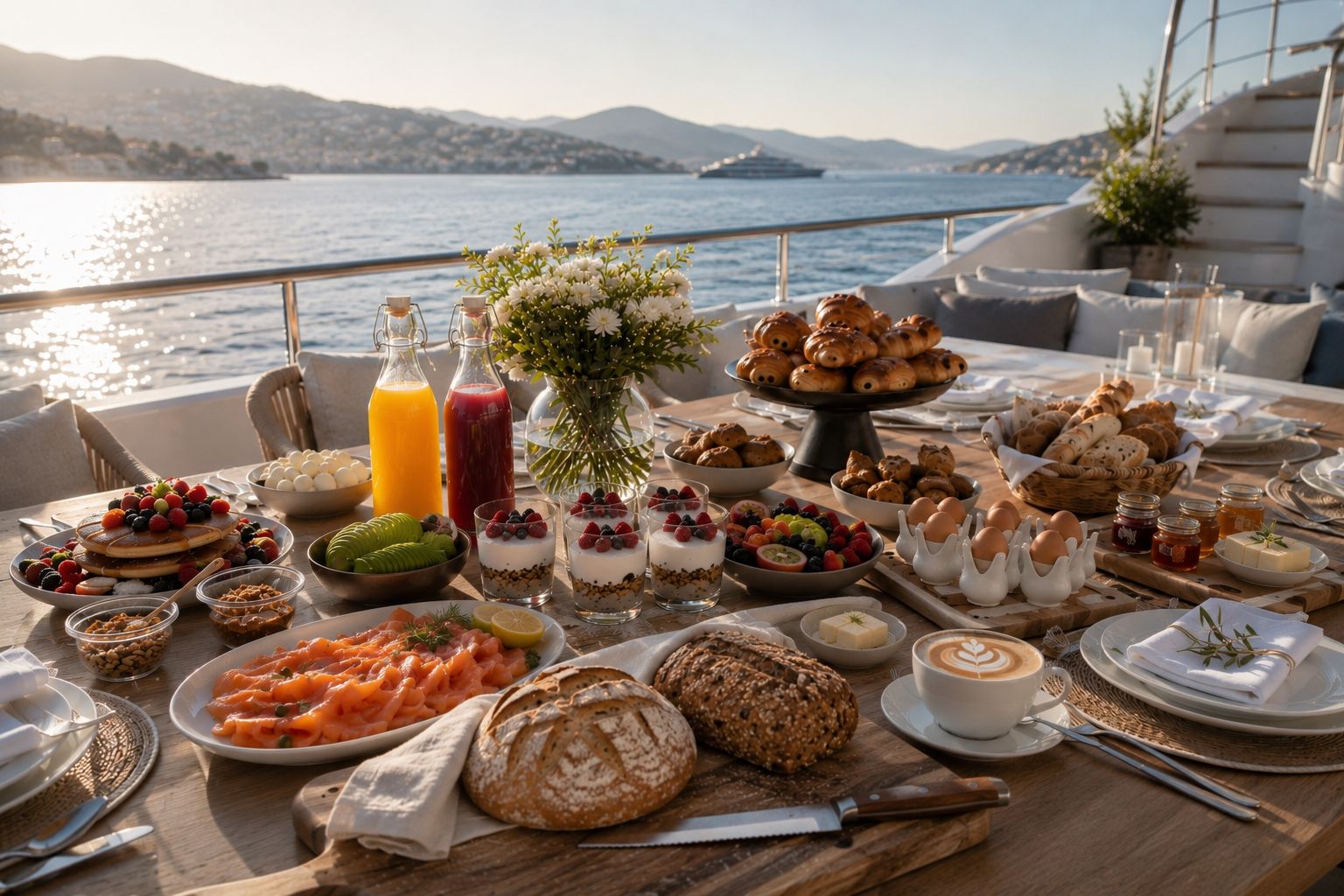
The yacht deck and the private lounge in the Old Port
The deck offers an unrivalled setting and a tiny galley. The number of hot dishes remains limited there, and a covered fallback is always planned in case of mistral.
The private lounge rented by the hour settles the kitchen question, since it has none. The service then becomes entirely mobile, and logistics take precedence over technique.
The technical survey: six non-negotiable points
Six points are measured before any proposal: power supply, water points, worktop length, available refrigeration, unloading access and waste removal. A single missing point changes the menu, and two missing points change the venue.
This survey precedes any written proposal. The same logic already ran through our latest article on culinary team building for a sales team, where the kitchen actually available determined the set-up chosen.
The continuous buffet and what holds for two hours without deteriorating
A delegation brunch is not an extended breakfast. It is a menu built to withstand time, since the last plate is served long after the first.
The families of dishes that last the distance
Terrines, pâtés en croûte, marinated vegetables, breads and travel cakes withstand waiting without losing their texture. Fish tartares, mousses and delicate puff pastries hold up poorly, and they come out in timed sequences.
A dish's staying power is judged by its texture after forty minutes at room temperature. This test comes before any recipe makes it onto a brunch menu, and every year it rules out preparations that are nonetheless successful in the kitchen.
The hot sequence, the one key moment of the service
A single hot sequence is enough, and it must be visible. Scrambled eggs made to order, crispy pancetta or socca drawn from the tray create a meeting point, and this point shapes the flow around the buffet.
Low-temperature cooking comes into its own here for meats and fish served warm. It frees up the brigade at peak time, and the texture remains consistent from start to finish of the service.
Plated service, for the signature dish only
One dish per service is plated in front of the guest. This gesture shows the level of the cooking, and it turns a buffet into a chef's service.
This dish is chosen according to the market, not from a catalogue. The decision is made the day before, after the visit to the market.
The rest of the menu consists of finger food, with no knife needed. A delegation on the move does not cut, and a plate held in one hand leaves the other free for a handshake.
Speaking to the palates of a panel from three continents
Travel retail brings together Asian, Middle Eastern, European and American buyers in the same room. A brunch that ignores this diversity fails as a welcome, and it fails first thing in the morning.
What the first meal of the day means depending on origin
Breakfast is the most culturally marked meal of the day. A guest from Seoul or Taipei does not expect the same register as a guest from Frankfurt, and yet a single buffet can serve both.
Two parallel registers are therefore better than a compromise. A hot savoury register and a sweet travel-cake register sit side by side on the same buffet, and neither is presented as the secondary option.
The codes of travel retail on the plate
Trade show visitors spend part of the year in airport terminals and duty-free shops. They know the major perfume, confectionery and spirits houses better than anyone, and they immediately spot a generic product.
The menu therefore relies on identifiable, named producers. Locavore sourcing is not a marketing argument here; it is the condition for holding a conversation with this audience.
The trap of the so-called international menu
A menu that tries to please everyone ends up resembling nothing. A clear Provençal menu, explained in two languages, serves the delegation better than a patchwork of references borrowed from four continents.
The nuance lies in the techniques, not the produce. Wok cooking or a tangy marinade are welcome on the menu, provided they serve a product from the coast.
This question of registers already shaped the business breakfast for Asian buyers, designed for this same audience. The two formats share the same standards, and differ mainly in the length of service.
The October basket between the Côte d'Azur and Marseille
The trade show falls at the turn of October, when Provence leaves summer behind and enters autumn. This shift makes for a precise menu, and it rules out certain products that clients still ask for.
What the region offers in October
Muscat grapes, late-season figs, chestnuts from the Massif des Maures, the first porcini and squashes all arrive together. Small-scale day-boat fish remains plentiful at the Mediterranean fish auctions, and mackerel and bonito are at their best.
Tomatoes and melons, on the other hand, no longer compare with their summer versions. They are ruled out without discussion, even when the host asks for them by name.
The supply channels used
Cannes' Forville market supplies the morning top-up, while the Capucins market and producers from the Marseille area provide the core. Orders go out several days before the service, and each item has an identified fallback.
On Mondays, the Forville market hall makes way for a flea market and no longer sells fresh produce. This closure is checked before writing even the first draft of the running order, and it moves the market visit to the day before.
The fallback when deliveries fall short
A missing delivery must never knock a dish off the menu. Each recipe carries a substitute product written down in advance, and the guest cannot tell the difference.
The cruise retail segment follows a similar supply calendar, as described in the private dinner for a cruise retail delegation. The October season sets the same limits there, and the same fish auctions supply both services.
Coffees, teas, fresh juices and the alcohol-free offering
At a delegation brunch, drinks matter as much as the plate. Poorly handled coffee spoils an otherwise successful service, and it is noticed faster than sloppy plating.
Coffee, the first test of a service's seriousness
Clean extraction is worth more than large capacity. Roaster's coffee, ground on site, says more to the trade show audience than an impressive machine filled with an anonymous blend.
Tea demands the same attention, and more variety for this panel. Three plain teas and one herbal infusion are enough, provided the water is at the right temperature for each.
Juices and the alcohol-free offering
Freshly pressed morning juices are a welcome replacement for cocktails in this slot. Citrus, grape and pomegranate provide a seasonal base, and a sugar-free flavoured water completes the offering.
Part of the panel does not drink alcohol, for religious or professional reasons. The alcohol-free offering is therefore built first, never added at the end of the proposal.
When wine has its place and when it does not
At a welcome brunch preceding a day of meetings, a single white wine from Provence is enough. Full food and wine pairing belongs to the dinner later in the week, not to the meal that opens the working day.
In this respect, this format differs from the business lunch in a hospitality suite on the Croisette, where the wine list carries part of the message. The welcome brunch deliberately keeps a short offering, and this restraint is a choice, not a lack of means.
The pop-up brigade, plating and clean-up
A service of this kind is run by a pop-up brigade put together for the week. It is not improvised on site, and its size is determined by the technical survey of the venue.
How the brigade is sized
A suite pantry caps production at two people working effectively. A villa kitchen accommodates four, and beyond that the brigade gets in its own way more than it produces.
Front-of-house service follows a different logic from production. On a continuous buffet, a replenishment station and a guest-contact station share the work, and the guest-contact station never leaves the room.
French service adapted to the continuous buffet
Russian service and English service require a seated table. On a buffet, adapted French service is the natural choice, with dishes presented and served with assistance.
This approach preserves the presentation of the dishes and contact with the guest. On the other hand, it requires more staff presence, and it is what distinguishes a chef's service from a caterer's delivery.
Clean-up, the invisible part of the service
The delegation leaves for the Palais in late morning. The venue must be returned intact within the following hour, and this constraint appears in the running order from the very first version.
The brigade takes its waste away and returns the pantry to its original condition. A hotel suite left in disarray damages the host's relationship with the establishment, and that relationship matters more than the service itself.
Summary table of welcome brunch formats
Brunch format | Typical venue | Suitable group size | Main constraint |
Suite brunch | Hotel suite facing the Palais | Small standing group | Mise en place moved off site to a production kitchen |
Villa brunch | Private villa for the week | Full delegation | Road transfer to be built into the programme |
Deck brunch | Yacht moored at the quay, small galley | Small committee | Covered fallback mandatory in case of mistral |
Private lounge brunch | Rented lounge without a kitchen | Medium-sized group | Entirely mobile service |
Stand brunch | Brand space at the trade show | Continuous flow of visitors | Venue regulations and set-up slots |
Mixed brunch in two hubs | Villa with usable terrace | Large delegation | Two brigades and double replenishment |
The group sizes shown assume production carried out on site, not platters brought in. They vary according to the technical survey of the venue, and one less pantry shifts the entire row.
This table is a starting point, not a conclusion. The final format is decided once the venue has been visited, and the written proposal comes after this survey.
Illustrative service case
What follows is a working example, not a client review. The constraints brought together here come from several weeks of trade shows and serve to show how a set-up is decided, and no real person appears in it or is paraphrased.
A spirits house welcomes its distributors from eight different markets in Cannes, on the morning before its first day of meetings. Arrivals are spread over three waves, and the last wave lands when the first has already finished its coffee.
The chosen venue is a suite on the Croisette, selected for its proximity to the Palais des Festivals. The technical survey reports a pantry with no oven, two hobs and a single sink, which rules out any long cooking on site.
The mise en place is therefore prepared in a production kitchen the evening before. Terrines, marinated vegetables and breads travel ready-assembled, and only the hot sequence remains to be done in front of the guests.
The October basket sets the menu without negotiation. Late-season figs, chestnuts, roasted squash and marinated bonito make up the savoury register, and muscat grapes round off the sweet register.
The first difficulty arises with the coffee, as the suite has only one usable socket at a time. The grinder and the machine take turns on this same power point, and replenishment is timed to the waves of arrivals.
The second difficulty is linguistic, as the panel brings together four working languages. The names of the dishes are written in two languages on cards placed in front of each dish, and the guest-contact station repeats the essentials orally.
The hot sequence falls on the second wave, the largest. It brings together in the same room guests who arrived at three different times, and it is at this moment that the group truly comes together.
The suite is handed back within the hour following the delegation's departure. The set-up described here constitutes neither a promise nor a guarantee of results, and each proposal is built after a visit to the venue.
Frequently asked questions
Can a welcome brunch replace the delegation's dinner?
It does not replace it; it opens the week. The dinner retains its role as a highlight, and it is best placed on the second or third evening.
How long can a continuous brunch last?
Two and a half hours is the reasonable limit for this format. Beyond that, the menu deteriorates or production has to start from scratch, and a second hot sequence becomes necessary.
What happens if the suite has no kitchen at all?
The mise en place is prepared in a production kitchen and only the tasks that can be done on site are carried out there. The menu then adapts to dishes that travel ready-assembled, and the hot sequence is reduced to a single step.
Are dietary requirements and religious restrictions an obstacle?
If announced in advance, they are not. The buffet incorporates the specified diets from the outset, and no one ends up in front of a substitute plate.
Do you travel to Cannes from Marseille or are you based on site?
The brigade is assembled in Marseille and travels throughout the Côte d'Azur. The production kitchen for the mise en place is chosen according to the venue of the service, and the cold-chain logistics are sized for the journey.
How do I get a proposal for a delegation attending Tax Free World?
The contact page is all it takes to start the conversation: the trade show dates, the breakdown of arrivals and the intended venue provide the necessary basis. The written response follows, once the technical survey has been carried out on site.
Organising your delegation's welcome brunch at Tax Free World
Lory Herschkorn and Fabien Mimoun form the Monsieur et Madame duo, private chefs based in Marseille and working throughout the Côte d'Azur. Their services cover the entire Cannes week, from the welcome brunch to the closing dinner.
Send us the trade show dates, the breakdown of arrivals, the number of guests actually expected and the intended venue. The set-up is built from these elements, and nothing is proposed before the venue has been seen.


