Private chef in a villa in Cannes: planning seven days of meals for a family week
Contents
Introduction
A week in a villa in Cannes is not prepared like a one-off dinner. Seven days of meals form a system, with mealtimes that drift, outings decided the same morning and guests who do not all eat the same thing.
The usual reflex is to deal with the question day by day, and therefore to go through it twice: once when shopping, once in the kitchen. The private chef's job is to absorb this double burden and turn it into a flexible plan.
The pages that follow describe the real mechanics of a family stay in a villa: advance planning, the rhythm of the three daily services, the place of children, the evenings left free. They also describe what remains the household's responsibility, because a successful stay is not one where the chef does everything.
Lory Herschkorn and Fabien Mimoun work as a duo, one focusing on French cuisine, the other on world cuisines. This division makes it possible to go seven days without repetition, something a single cook finds hard to sustain over a long stay.
A week in a villa is not the same dinner seven times over
The difficulty of a long stay is not technical, it is combinatorial. Seven dinners, seven lunches and seven breakfasts must follow one another without anyone feeling they are rereading the previous day's menu.
A chef who thinks day by day runs through their signature ingredients in three days and ends the week repeating themselves. The menu is therefore built on the scale of the entire stay, with a deliberate progression rather than one left to chance.
How the culinary registers progress over seven days
The start of the stay remains simple and Mediterranean, while the household's habits become clear. The two or three most elaborate dinners are placed in the middle of the week, once the guests have found their rhythm.
The end of the stay deliberately eases back towards sharing dishes and slow cooking. The last dinner is often the most convivial, rarely the most technical.
What the villa imposes on the menu
A villa kitchen is still a home kitchen: a domestic oven, a short worktop, no blast chiller. Our private chef and catering service for villas in Cannes starts from these practical constraints, rather than from a restaurant menu transposed as is.
The size of the fridge, the number of high-heat burners and the size of the oven are noted before a single line of the menu is written. These three figures dictate half of the week's choices, from cooking methods to service formats.
Advance planning: guest numbers, pace and dietary restrictions
Everything begins with a set of information, sent a few days before arrival. Actual number of guests, children's ages, allergies, diets and approximate mealtimes are enough to build an initial outline for the week.
This brief is not an administrative questionnaire; it is the tool that avoids last-minute corrections. An intolerance reported the day before departure is handled in the design of the menu, not through improvisation.
The information that genuinely changes the plan
Three factors weigh more than the others: the number of guests in the evening, the time at which the household wishes to dine, and the number of meals taken out. Everything else is adjusted during the stay without disrupting the outline.
Scouting the kitchen completes this planning, as we explained in our article on the first arrival dinner in a villa. A single oven and a single high-heat burner rule out certain service sequences, and it is better to know this before promising a Saturday menu.
What the household does not need to decide
Families often believe they must settle seven menus before arriving. No menu is set more than forty-eight hours in advance, because the market and the weather decide as much as we do.
Tastes, on the other hand, are expressed very early and hardly change. Two or three stated dislikes are worth more than a detailed wish list that boxes the menu in.
Breakfasts in a house where everyone rises at their own pace
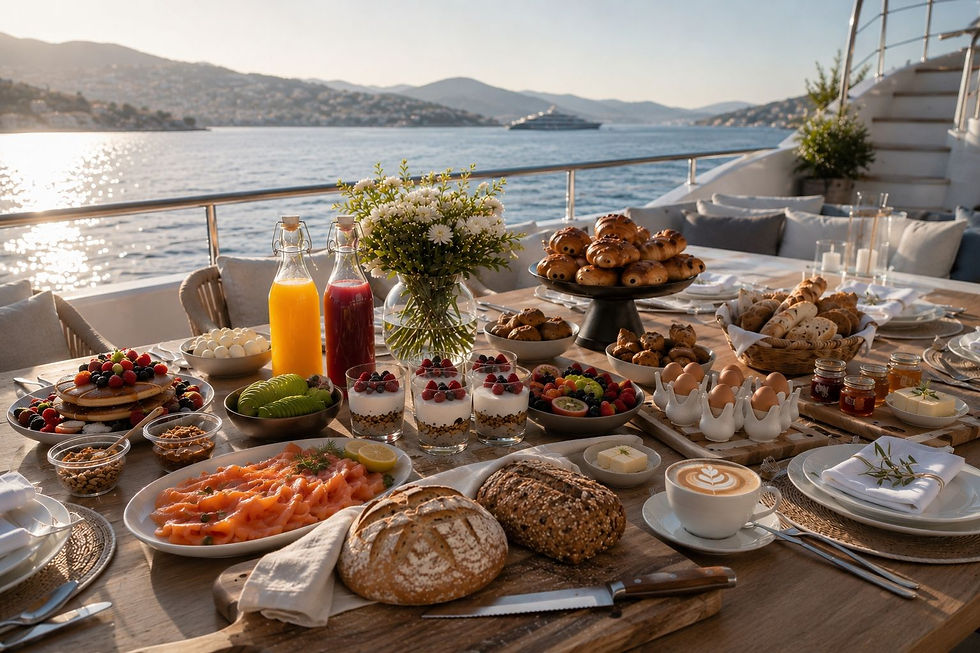
Breakfast is the most misunderstood service of a villa stay. It is not served at a set time; it stretches over three hours between the first person up and the last.
The answer is not a buffet left out all morning, which deteriorates in the heat. We set out a protected cold spread and a hot selection made to order, according to who actually turns up.
Stays with young children
Children get up early and eat quickly; adults arrive later and settle in at the table. Two waves are better than a compromise that ultimately suits no one.
Pastries and bread come from an artisan baker found near the villa, not from a supermarket. The difference shows from the second morning, and it is something families point out unprompted.
Lunches, shaped by outings and returns from the beach
Lunch is the least predictable meal of the week. Depending on the day, it is taken at the villa, not taken at all, or pushed back two hours without warning.
So we do not build seven lunches; we build the ability to serve a lunch that adapts to any configuration. The format changes, the standard remains the same.
Formats that can wait
The preparations that hold without suffering are well known: marinated vegetables, fish en escabeche, cold meats sliced to order, composed salads plated on arrival. Cooking just before service is reserved for dinner, when the timing is more or less kept.
A late lunch should not look like an early dinner. Freshness comes before technique, and portions stay measured so as not to spoil the evening.
The lunch nobody eats
Sometimes a family heads out for the day and cancels lunch that same morning. Ingredients already committed are switched to dinner or to the next day, which means planning for this switch at the time of shopping.
A picnic prepared the night before takes care of a good share of these days out. It travels in a cool box and is eaten without cutlery, a constraint that dictates the choice of dishes.
Terrace dinners, the backbone of the stay
Dinner is the only service whose time is more or less kept. It is therefore where the week's technical cooking takes place, including plated presentation.
The terrace imposes its own rules, the same as for a business lunch served in a hillside villa. Wind, residual heat and fading light affect sauces, serving temperatures and the order of the plates.
We avoid fragile emulsions and tall presentations, which do not survive a sea breeze. Plates leave the kitchen covered until they reach the table, and service is tightened to shorten the trip from the kitchen.
Plated service in a private home
French-style service, with dishes presented at the table, often suits a villa better than Russian-style service. It reduces trips back and forth to the kitchen and lets the table breathe between courses.
Food and wine pairings remain simple and local, centred on Provence whites and rosés. A villa's wine cellar is stocked in advance, based on what the household already enjoys drinking.
The amuse-bouche marks the start of the evening, especially when guests return from the beach. A single bite, served standing, is enough to draw the evening towards the table.
Children, afternoon snacks and a single table
The most frequent request from a family in a villa is not gastronomic but practical: that the children eat the same food as the adults. A single table is better than two separate services, for the kitchen as much as for the atmosphere.
The method follows the same logic as building a bespoke menu for a client: a shared main dish, then variations in cut and seasoning. The same fish is served plain for the youngest and dressed up for the adults' table.
Allergies and diets within a shared menu
A gluten-free or vegetarian guest is not given a substitute dish in full view of everyone. The menu is designed from the outset around what they can eat, and no one feels singled out.
Serious allergies require genuine separation of worktops and utensils. In a home kitchen, this means a precise production order rather than a second workstation.
The afternoon snack is not an improvised meal; it is a line in the plan. Two simple preparations a week are enough, often a travel cake and a prepared fruit dish.
The free evening and the meals we do not cook
A full week does not mean twenty-one services. Two evenings at a restaurant and a lunch at the harbour are part of a normal stay, and the plan includes them from the start.
A chef who tries to fill every slot does the family a disservice. The stay belongs to the guests, not to the culinary set-up arranged around them.
Fitting the plan around outings
Free evenings are set at the start of the stay, even if they are moved later. A free evening announced the day before can still be absorbed; announced the same evening, much less so, since the ingredients have already been ordered.
When the villa already has a housekeeper or household staff, the scope of each role is clearly defined. Knowing who plates, who clears and who tidies up avoids duplication, and this is the subject of our article on running a pop-up kitchen brigade.
Shopping, storage and a kitchen left in order
The invisible part of a villa week is the supply logistics. Three trips to the market and two top-up purchases generally structure a seven-day stay.
Seafood and vegetables come from the covered market and small producers, not from a single weekly shop. Forville market is our base in Cannes, supplemented by the fish auction and two market gardeners from the hinterland.
Storage is the most underestimated constraint: a household fridge cannot hold seven days' worth of ingredients. Supplies are therefore split up out of necessity, not out of a locavore sourcing principle.
The kitchen handed back after every service
The kitchen is cleaned and tidied after every service, not at the end of the stay. The family finds a usable room when they want to pour themselves a glass of water at midnight.
Leftovers are labelled, dated and left within easy reach in the fridge. Nothing is thrown away simply for convenience, and sauce bases are used for the next service.
Summary table of a typical week of villa meals
The table below shows a typical week, as it takes shape before any adjustments. No line is contractual; each day is fine-tuned the evening before.
Day of the stay | Breakfast | Lunch | Dinner |
Day 1 (arrival) | Not served | Not served | Settling-in dinner, quick cooking |
Day 2 | Cold spread and hot dishes to order | Light lunch at the villa | Mediterranean register, day-boat fish |
Day 3 | Two waves, children then adults | Day out, picnic prepared | Elaborate dinner, plated presentation |
Day 4 | Cold spread and artisan pastries | Late lunch on return from the beach | Free evening, outing in town |
Day 5 | Cold spread and omelettes made to order | Adaptable lunch | Mid-stay dinner, whole roast centrepiece |
Day 6 | Extended cold spread | Composed salads plated on arrival | Terrace dinner, French-style service |
Day 7 (departure) | Early breakfast | Not served | Not served |
Illustrative service example
The example below brings together several situations often encountered over the course of a single summer. It is not a real testimonial and no client is identified in it, neither by name nor by initial.
Ten guests, including four children aged four to twelve, stay for seven nights in a villa in the hills above Cannes. Two adults follow a gluten-free diet, and one of the children has a tree nut allergy.
The brief sent five days before arrival gives the number of guests, their ages, the dietary constraints and two fixed dates in the diary: a birthday dinner on the fourth evening and an early departure on the seventh morning. The rest of the plan remained open.
The chosen outline provided for five dinners served, five adaptable lunches and seven breakfasts in two waves. Two evenings were left free, including the fifth, to allow for an outing in town.
The villa kitchen had one oven and four burners, with no warming oven. This constraint ruled out dinners with three hot courses served simultaneously and pointed towards cold starters plated in advance.
The birthday dinner on the fourth evening brought together twenty guests, with outside guests joining. It was handled with French-style service, with two centrepieces presented at the table and a shared dessert.
The two gluten-free diets and the tree nut allergy were built into the shared menu, with no separate substitute dish. No separate table was laid, and the children ate the same ingredients as the adults, cut and seasoned differently.
Frequently asked questions
Do we need to settle all seven menus before arriving at the villa?
No, and it is not even desirable. An outline is enough before arrival; the menus are then set two days in advance according to the market and planned outings.
Is the private chef present from morning to night throughout the week?
The arrangement follows the agreed plan, service by service. The chef is present during the chosen slots, and free evenings remain free for the household.
What happens if the family comes back much later than planned?
Lunch and dinner are designed to cope with delays, with preparations that can wait without deteriorating. A one-hour delay changes nothing on the menu; a longer delay moves a dish to the following day.
Should children eat separately from adults?
No, that is precisely what the method seeks to avoid. The main dish is shared and the variations concern the cut, the cooking and the seasoning.
How are allergies handled in a villa kitchen?
They are declared before arrival and built into the menu design, not corrected at the time of service. A dedicated production order and separate utensils replace the second workstation that a home kitchen does not offer.
Who takes care of the shopping and tidying the kitchen?
Sourcing, storage and tidying up after each service are part of the service. The kitchen is left usable after every session, and leftovers are labelled and left within easy reach.
Building the plan for your villa week in Cannes
How many nights, how many guests, which evenings are already taken by an outing: a weekly outline takes shape from these three answers. Dietary constraints and the children's ages complete the picture, and the proposal then comes back service by service.